


Transform Excel data into stunning charts with AI in seconds.
Creating charts from Excel data used to mean wrestling with formatting options, tweaking axis labels, and spending hours getting your visualization just right. AI has changed everything. Today, you can transform raw spreadsheet data into professional, publication-ready charts in seconds.
This guide walks through exactly how to make charts from Excel data using AI tools, whether you are building a quick sales report or a polished investor presentation.
Why Use AI to Create Charts from Excel Data?
Before getting into steps, it helps to understand why AI chart generation is changing daily reporting workflows.
Traditional Excel Charting Problems
Manual charting often introduces avoidable friction:
- Time consumption: Many professionals spend 2 to 3 hours per week creating and formatting charts manually.
- Limited options: Built-in chart defaults often look outdated without extra customization work.
- Steep learning curve: Advanced chart types require Excel expertise that many non-analysts do not have.
- Inconsistent results: Different teammates produce visuals with inconsistent quality and style.
AI Chart Generation Benefits
AI tools improve both speed and consistency:
- Speed: Generate charts in under 30 seconds rather than 15 to 30 minutes.
- Intelligence: Let AI recommend the most suitable chart type from your data shape.
- Professional design: Produce presentation-ready visuals without design-heavy effort.
- Accessibility: Enable non-experts to create advanced charts quickly.
Step-by-Step: Creating Charts from Excel Data with AI
Step 1: Prepare Your Excel Data
Good charts start with clean structure. Use these preparation rules:
- Put headers in the first row so labels map cleanly.
- Keep data continuous without blank rows.
- Use consistent number/date formats.
- Remove merged cells before export.
Example structure:
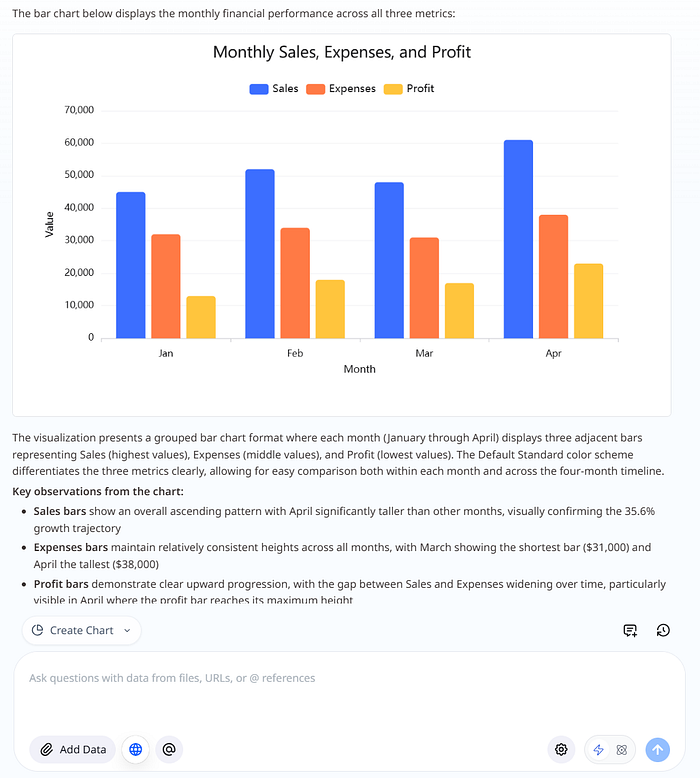
| Month | Sales | Expenses | Profit |
| Jan | 45000 | 32000 | 13000 |
| Feb | 52000 | 34000 | 18000 |
| Mar | 48000 | 31000 | 17000 |
| Apr | 61000 | 38000 | 23000 |
Step 2: Export or Copy Your Data
Three practical ways to move Excel data into an AI chart tool:
Option A: Direct Copy-Paste
- Select your data range including headers.
- Copy with Ctrl+C (or Cmd+C on Mac).
- Paste directly into the AI tool.
Option B: Save as CSV
- Open File -> Save As.
- Choose CSV (Comma delimited).
- Upload the CSV file to the AI chart generator.
Option C: Natural Language Input
For simple cases, describe your values directly:
"Create a bar chart showing Q1 sales: January $45K, February $52K, March $48K, April $61K"
Step 3: Choose Your AI Chart Generator
Different AI tools can convert Excel data into visuals. Compare them on speed, style quality, and ease of use.
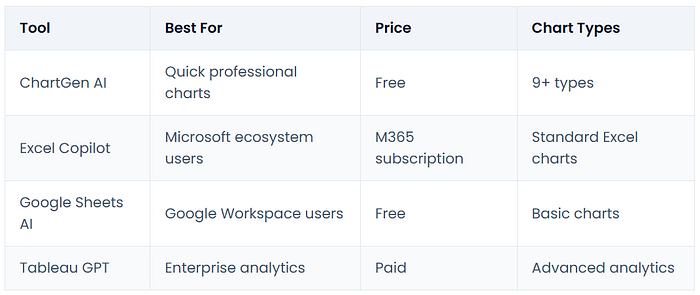
For most users, ChartGen offers a strong balance of speed, quality, and accessibility.
Step 4: Generate Your Chart
Using ChartGen as an example workflow:
- Open chartgen.ai.
- Paste data or upload your CSV.
- Add context, for example: "This is monthly sales data for 2024".
- Click Generate and wait a few seconds.
- Review the AI-selected chart type.
AI usually determines:
- The best chart type (bar, line, pie, and more)
- Axis scaling
- Color choices for clarity
- Labels and legends
Step 5: Customize and Export
After generation, refine only what matters:
- Switch chart type if your audience needs a different view.
- Adjust colors for brand alignment.
- Update chart titles and labels.
- Add annotations to emphasize key numbers.
Typical export formats:
- PNG for slides
- SVG for web and scaling
- PDF for docs
Best Chart Types for Common Excel Data
AI suggestions are helpful, but understanding chart selection logic improves outcomes.
For Time-Based Data (Monthly Sales, Daily Traffic)
Recommended: Line chart or area chart.
Use when:
- The X-axis is chronological
- You need trend direction
- You compare multiple series over time
For Category Comparisons (Sales by Region, Revenue by Product)
Recommended: Bar chart or column chart.
Use when:
- Comparing distinct categories
- Showing rankings
- Presenting survey responses
For Part-to-Whole Relationships (Budget Allocation, Market Share)
Recommended: Pie or donut chart.
Use only when:
- You have five or fewer categories
- Values sum to 100%
- You need proportion emphasis
For Correlation Analysis (Price vs. Sales, Age vs. Income)
Recommended: Scatter plot.
Use when:
- Each point represents one record
- X and Y represent different variables
- You want to see relationship strength
For Multi-Dimensional Data (Performance Metrics, Survey Scores)
Recommended: Radar chart or heatmap.
Use when:
- Comparing many attributes simultaneously
- Finding patterns in larger tables
- Spotting outliers quickly
Real-World Examples: Excel to AI Chart
Example 1: Sales Performance Dashboard
Original Excel Data:
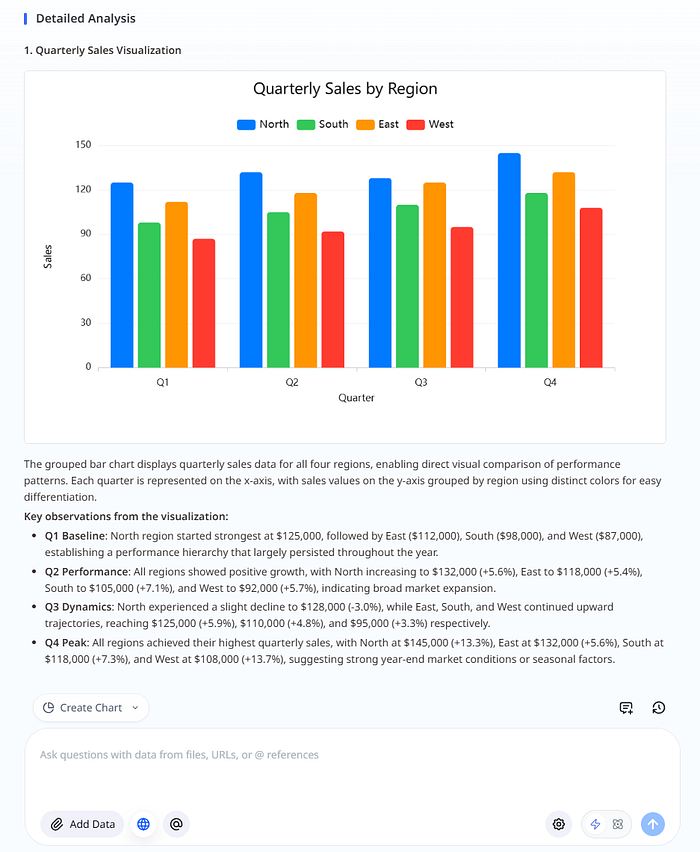
| Quarter | North | South | East | West |
| Q1 | 125000 | 98000 | 112000 | 87000 |
| Q2 | 132000 | 105000 | 118000 | 92000 |
| Q3 | 128000 | 110000 | 125000 | 95000 |
| Q4 | 145000 | 118000 | 132000 | 108000 |
AI prompt: "Create a grouped bar chart showing quarterly sales by region."
Result: A grouped bar chart with clear labeling and color coding.
Example 2: Budget Breakdown
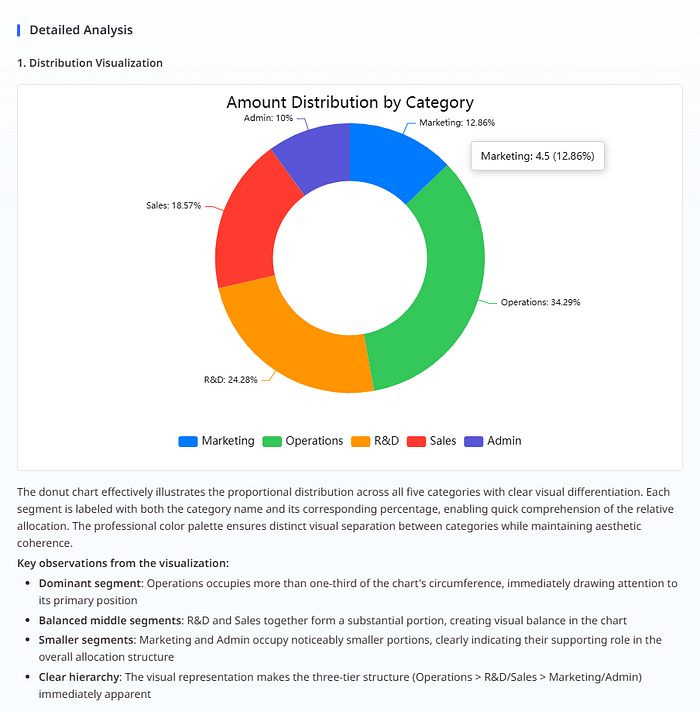
Original Excel Data:
| Category | Amount |
| Marketing | 45000 |
| Operations | 120000 |
| R&D | 85000 |
| Sales | 65000 |
| Admin | 35000 |
AI prompt: "Show this as a pie chart with percentages."
Result: A donut chart with percentages and clean category separation.
Example 3: Trend Analysis
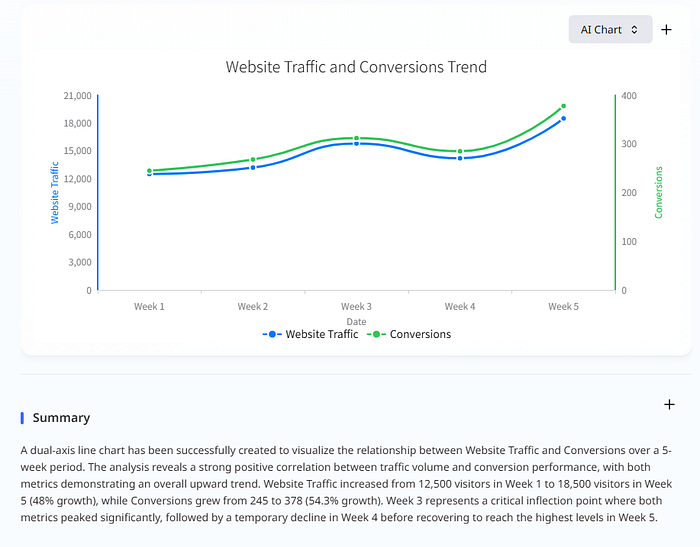
Original Excel Data:
| Date | Website Traffic | Conversions |
| Week 1 | 12500 | 245 |
| Week 2 | 13200 | 268 |
| Week 3 | 15800 | 312 |
| Week 4 | 14200 | 285 |
| Week 5 | 18500 | 378 |
AI prompt: "Create a dual-axis line chart showing traffic and conversions over time."
Result: A dual-axis trend view that supports fast comparison.
Advanced Tips for Better AI-Generated Charts
- Provide context in prompts so AI aligns style and detail level.
- Clean data before upload to avoid misleading outputs.
- Iterate on first results instead of accepting the first chart blindly.
- Match brand colors when sharing externally.
Common Mistakes to Avoid
- Using too many data points in one chart.
- Ignoring AI chart-type recommendations without reason.
- Skipping accuracy checks before sharing.
- Over-customizing visuals and reducing readability.
Frequently Asked Questions
Can AI charts match a company style guide?
Yes. Most tools support color customization, and SVG export allows deeper editing later.
Is Excel data secure in AI chart tools?
Use reputable tools and review privacy policies. Many modern tools process data without permanent retention.
What if AI picks the wrong chart type?
Regenerate with a specific instruction, such as "Create this as a line chart instead."
Can I edit the chart after generation?
Yes. Use built-in edits first, then export to SVG for advanced adjustments.
Conclusion: The Future of Data Visualization
Creating charts from Excel data with AI is not only faster. It also broadens who can build high-quality visuals.
The key is still data literacy: understand the decision you need to support, then let AI handle visual execution.
If your team still spends most analysis time formatting charts, this workflow shift can unlock faster decisions with less friction.
Key Takeaways
- AI chart generation can dramatically reduce chart production time.
- Cleaner input data leads to better visual outputs.
- AI chart-type suggestions are often a strong starting point.
- Accuracy checks remain essential before sharing.
- Better prompt context produces better charts.